Author: Khandakar Ohida

  • Dhekhasona

    Dhekhasona

    Video installation, 4 min 46 sec, 2019

    Dhekhasona is a colloquial Bengali word commonly used when the groom’s family visits the bride before marriage. This term reflects the harsh reality of perceiving women’s bodies as commodities, reducing them to blank slates upon which society imposes its narcissistic fantasies. The video projection in this artwork vividly portrays the objectifying foreign gaze upon a woman’s body within the cultural framework of a family structure.
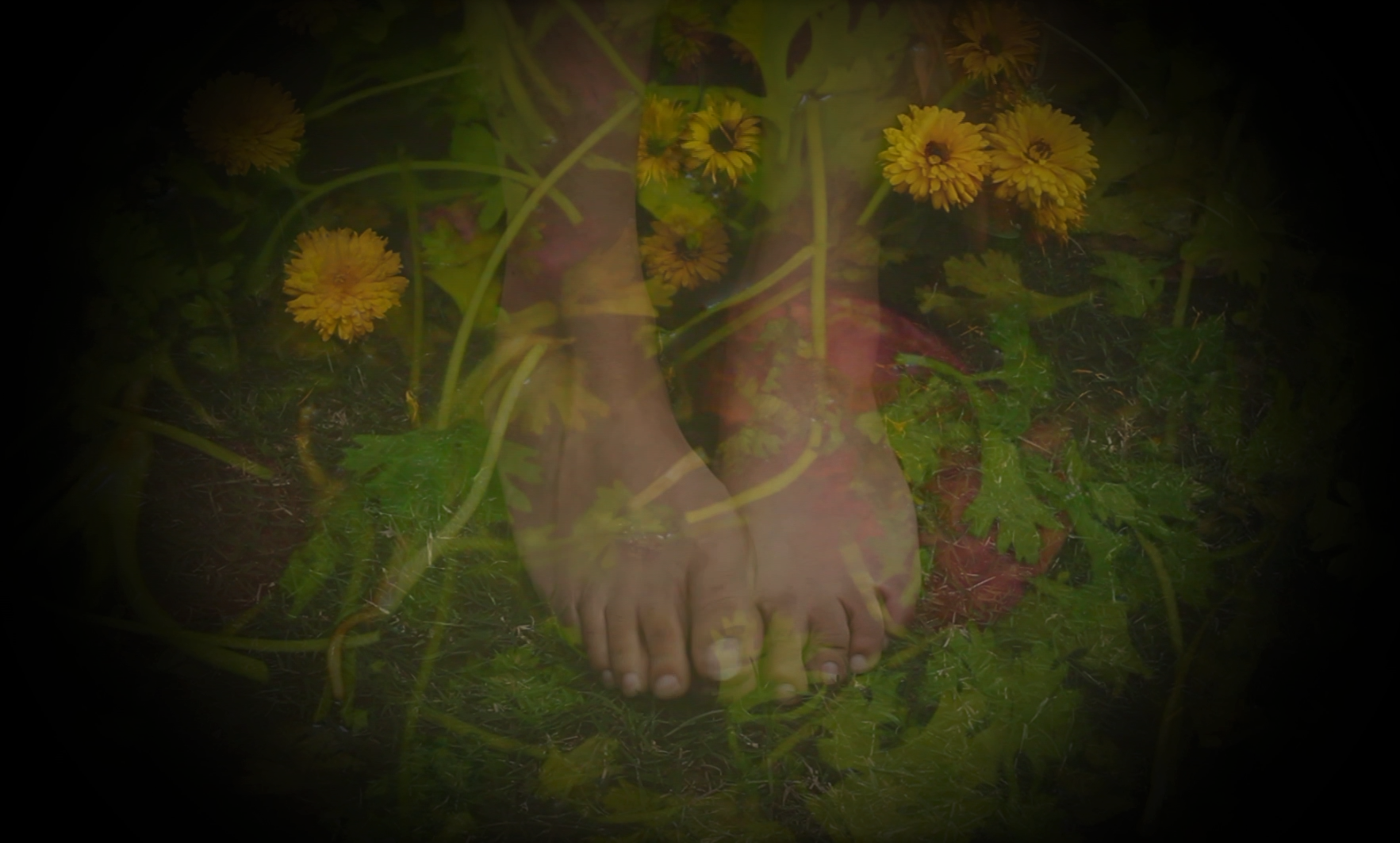
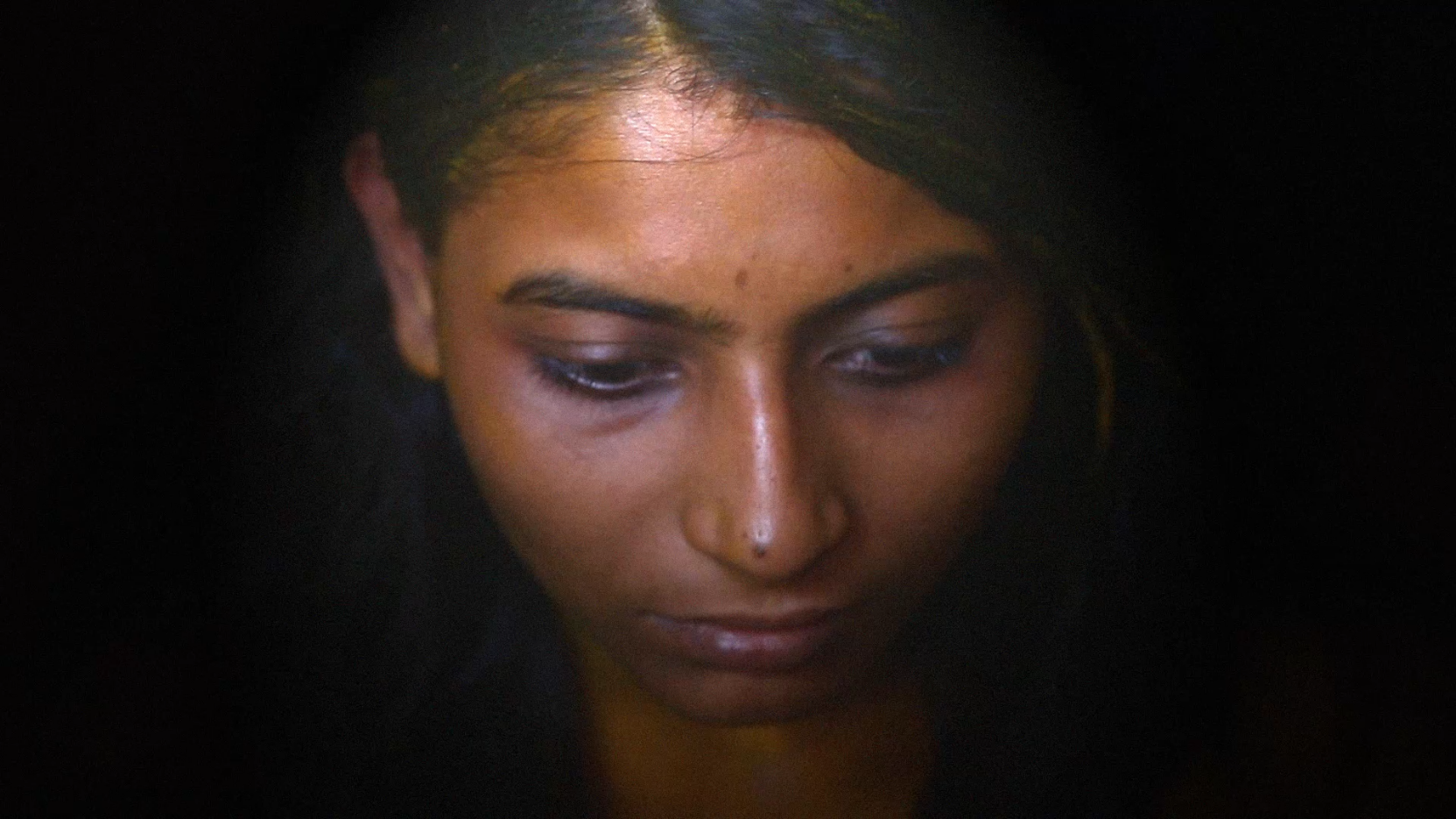
    Video still from Dhekhasona — bare feet among dandelions, the image suffused with darkness, evoking surveillance and the reduction of a woman's body to surface and spectacle.
  • Beyond Monochrome

    Beyond Monochrome

    Video art, 4 min 11 sec, 2019

    This one-channel video work combines various footage to interrogate the concept of gender roles within the institution of marriage. It delves into the complexities of how historically oppressed individuals navigate societal expectations, and examines the extent to which they have been able to find avenues of resistance and achieve emancipation. In doing so, it underscores the significance of acknowledging the elements that have remained unchanged despite progress.

  • Dark Flower

    Dark Flower

    Watercolour on paper, 18 × 12 inches each, 2019

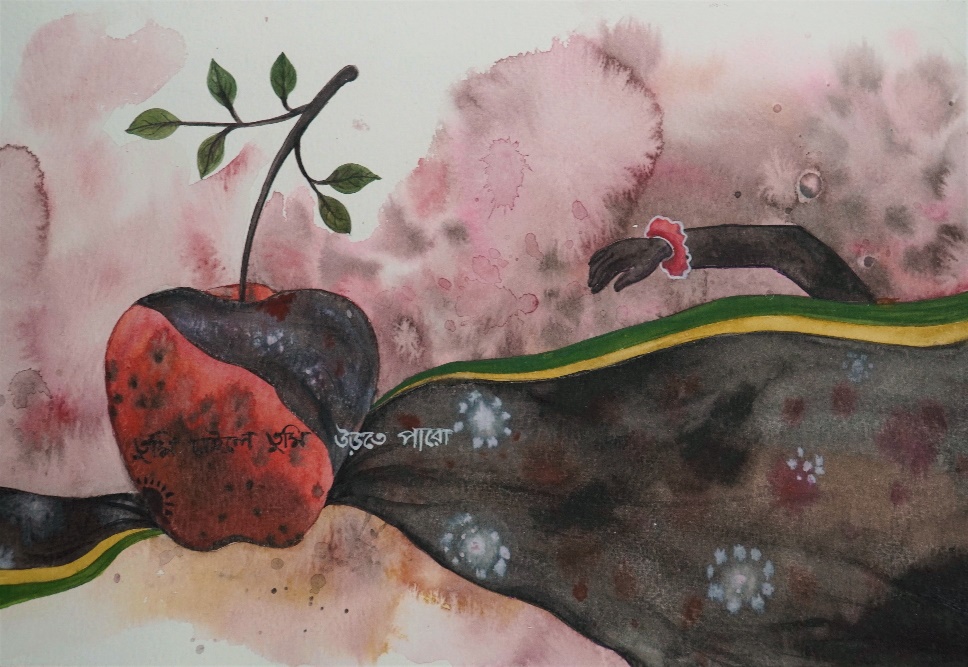
    Dark Flower (panel 4), watercolor on paper, 18 x 12 inches, 2019. A reclining figure draped in a dark patterned textile, a large red apple with green sprouting leaves resting where the head should be, Bengali script visible on the fabric. A reaching dark hand emerges at right against blossoming pink washes.
    Panel 1
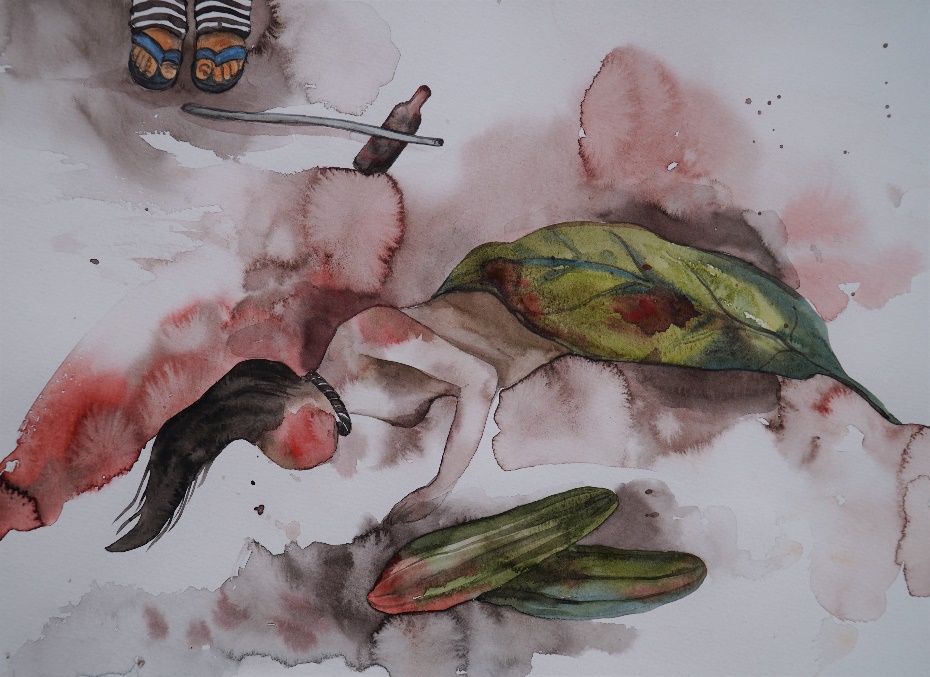
    Dark Flower (panel 2), watercolour on paper, 18 x 12 inches, 2019. A prone female figure with dark flowing hair reaches forward across a ground of crimson washes, surrounded by large botanical forms — a vivid green leaf and dark seed pods — with a small medicine dropper above.
    Panel 2
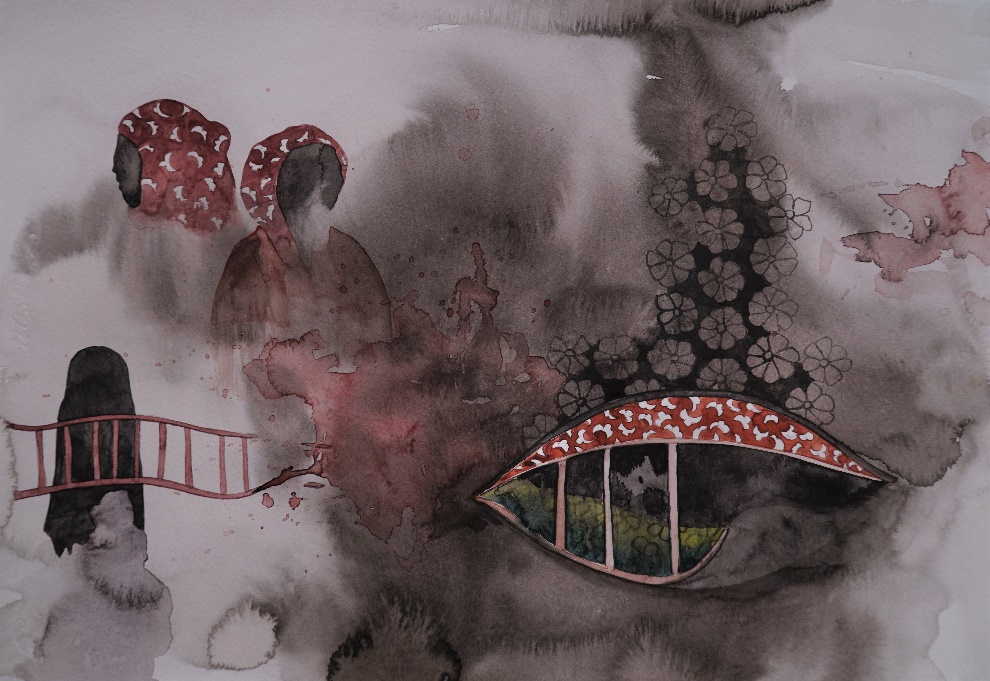
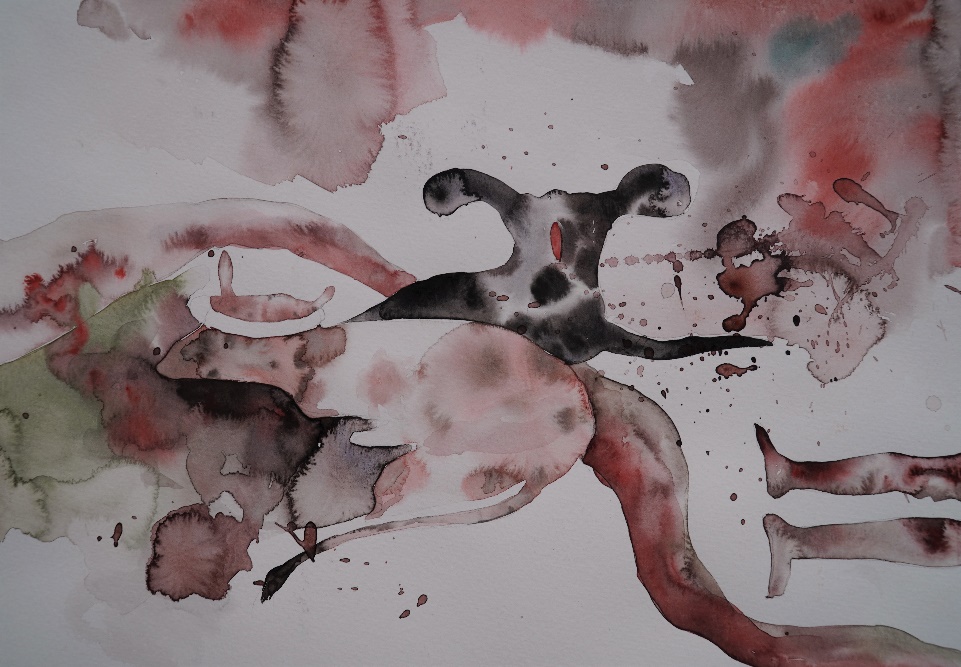
    Dark Flower (panel 3), watercolour on paper, 18 x 12 inches, 2019. An abstracted, visceral composition of interlocking limbs and organic forms in dark rose, grey, and black washes, dissolving the boundary between the human body and fluid matter.
    Panel 3
    Dark Flower (panel 4), watercolour on paper, 18 x 12 inches, 2019. A reclining figure draped in a dark patterned textile, a large red apple with green sprouting leaves resting where the head should be, Bengali script visible on the fabric.
    Panel 4

  • Really Fresh

    Really Fresh

    Drawing installation, drawing and watercolour on paper, 56 × 8 inches, 2019

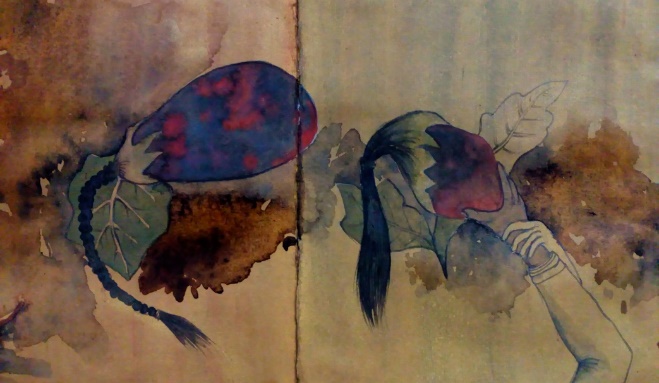
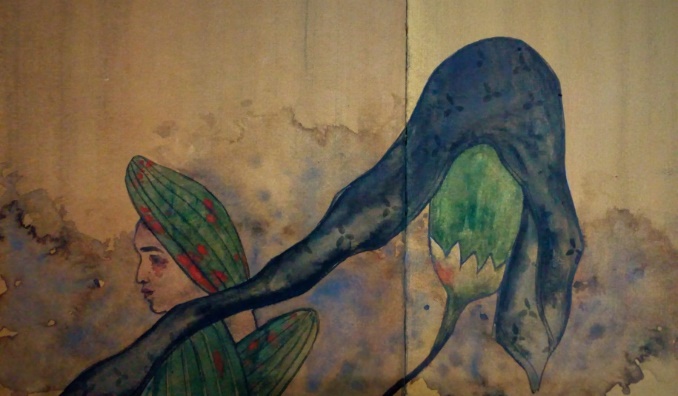
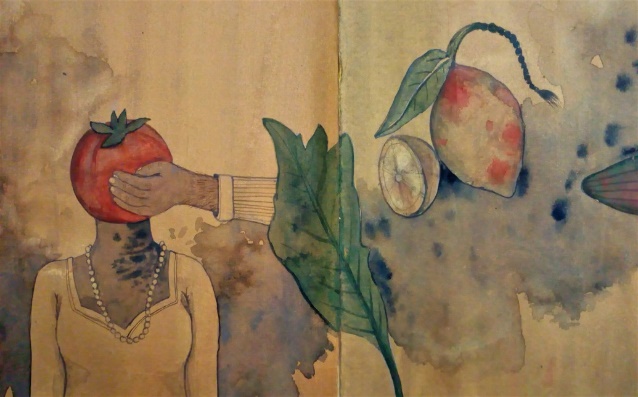
    The central focus of Really Fresh is to question the act of chopping and its connection to violence within a specific context. Through this piece, Ohida explores the metaphorical reality of recurring domestic violence, symbolically represented by the erosion of vegetables. The gradual deterioration of the vegetables serves as a metonymic representation of the extensive mutilation experienced by the victims of such violence.

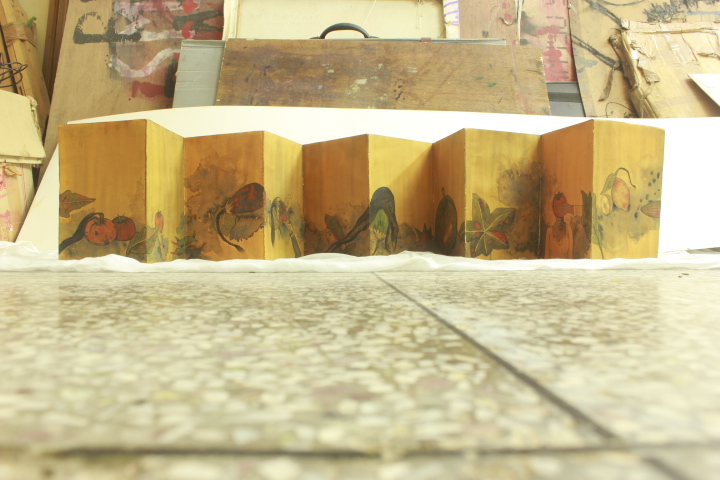
    A sequence of female figures whose heads are replaced by vegetables — eggplant, watermelon, tomato, mango — set against a warm golden ground. The repeated act of chopping and carrying functions as a metaphor for domestic violence. The work is also displayed as a folded accordion book.

    Really Fresh (full view), drawing and watercolour on paper, 56 x 8 inches, 2019. A panoramic horizontal composition depicting a sequence of female figures whose heads are replaced by vegetables — eggplant, watermelon, tomato, mango — set against a warm golden ground.
    Really Fresh — full view

    Details

    Really Fresh (detail), two panels showing a dark-haired figure bowing beneath a large purple eggplant, the vegetable and figure merging through overlapping watercolour washes.
    Really Fresh (detail), a figure in profile wearing a striped green headscarf extends a long dark form — part veil, part vegetable — outward from the body in a gesture of offering or struggle.
    Really Fresh (detail), a female figure with a tomato pressed over her face by a reaching hand, beside a mango and large leaf rendered in ink and watercolour.
    Really Fresh (installation view), the work displayed as a folded accordion book standing upright on a studio surface, revealing the sequential panels of the drawing installation.
    Displayed as a folded accordion book
  • Mother’s Arms Are More Comfortable

    Mother’s Arms Are More Comfortable

    Installation, 2019
    Next Step Residency Program, 1 Shanti Road, Bangalore, India

    This project portrays the profound impact of identity pressures on marginalised communities, offering a glimpse into the contextual reality of our society. Through this series, Ohida explores the inherent transparency of watercolour as a medium, which reveals incidental truths and invites introspection.

    The kinetic installation operates as a metaphorical panopticon, conveying the continuous propagation of oppression in our contemporary era , maintaining surveillance and perpetuating a sense of control. The rotating drum printed with figures enacts the endless repetition of violence.

    Exhibition installation view at 1 Shanti Road, Bangalore — a panoramic watercolour drawing hangs on the left wall, three photo ink paintings on Canson paper are mounted in the centre, and the kinetic installation on a white pedestal stands to the right against a black curtain. Next Step Residency Program, 2019.
    Exhibition view, 1 Shanti Road, Bangalore, 2019

    Mother’s Arms Are More Comfortable

    Photo ink on Canson paper, 12 × 8 inches each, 2019

    Mother's Arms Are More Comfortable — watercolour figure study showing a faceless, hooded figure seated on a branch, body saturated in deep red washes evoking bruising and blood.
    Mother's Arms Are More Comfortable — a second panel: a faceless seated figure in a white dress, limbs stained with red and crimson washes, surrounded by pink floral splashes.
    Mother's Arms Are More Comfortable — a third panel: a faceless figure in a headscarf cradles a prone body, both forms marked by red watercolour stains. The composition echoes the Mater Dolorosa.

    Kinetic Installation

    DC electric motor, 3 RPM, Canson paper, OHP print, 2019.

    Kinetic installation component — a cylindrical drum printed with figures in red rotates on a slender white pedestal against a black backdrop, driven by a DC electric motor at 3 RPM.

    Panoramic Works

    Panoramic watercolour and ink drawing — a narrative frieze depicting figures including a woman in traditional dress holding a flower, a praying figure, wrestlers, and a floating face in a headscarf, all rendered against loose rust-red washes. Watercolour on Canson paper, 2019.
    Detail of watercolour wash used in the installation — an abstract horizontal expanse of red, crimson, and ochre blooms on paper, suggesting organic cellular forms or spreading bruises.
  • The Home and the Globe

    The Home and the Globe

    Installation, 2018
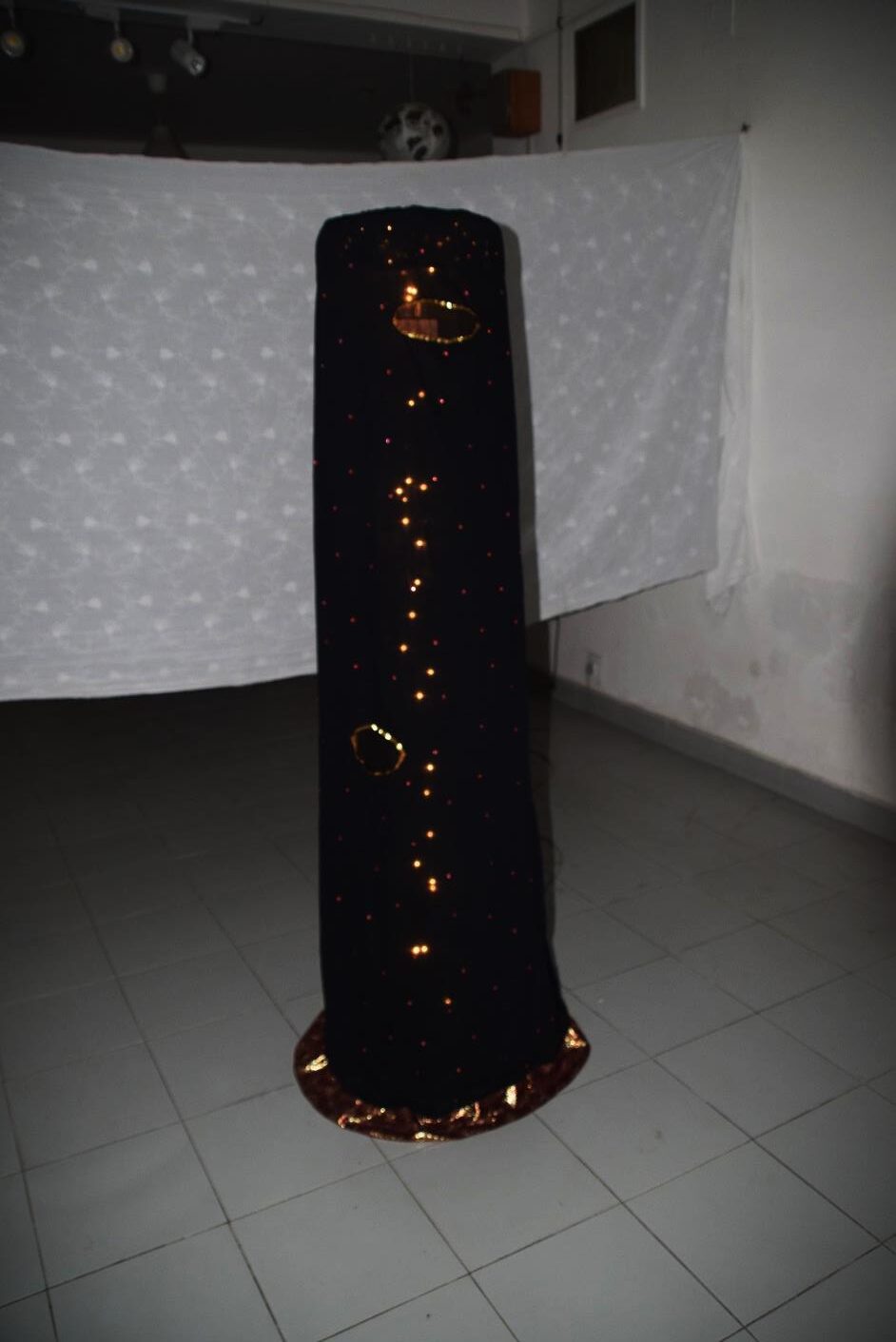
    Black cloth, embroidery stones, readymade ribbon, chain of zero-watt lights
    Top: 14 in. diameter · Bottom: 20 in. diameter · Height: 66 in.

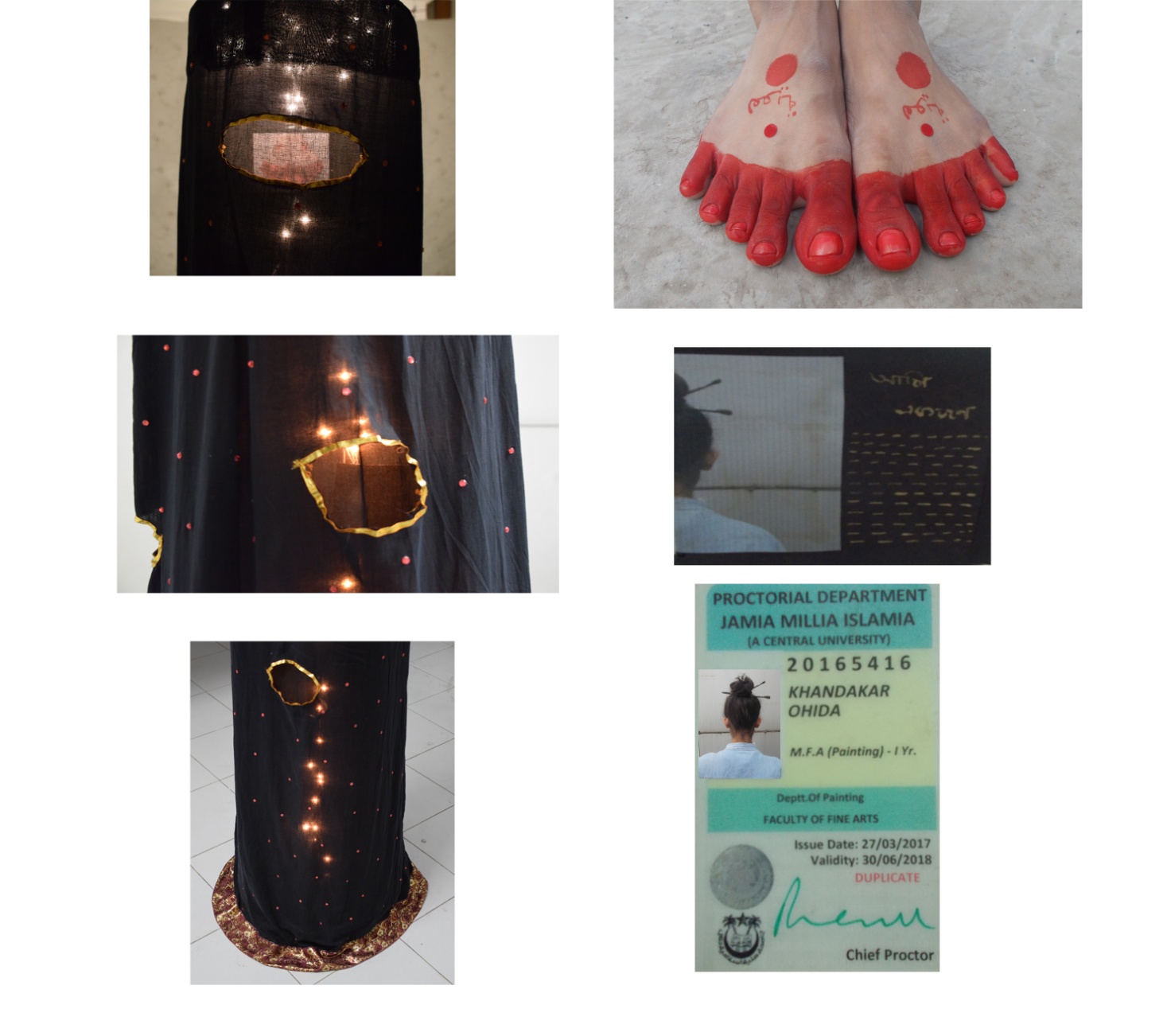
    This installation reflects exploration of the veil and its social implications. The creation of a monumental structure with two layers of veils symbolises the presence of patriarchy within society. By resembling the phallus, the installation aims to address and challenge the power dynamics associated with patriarchy.

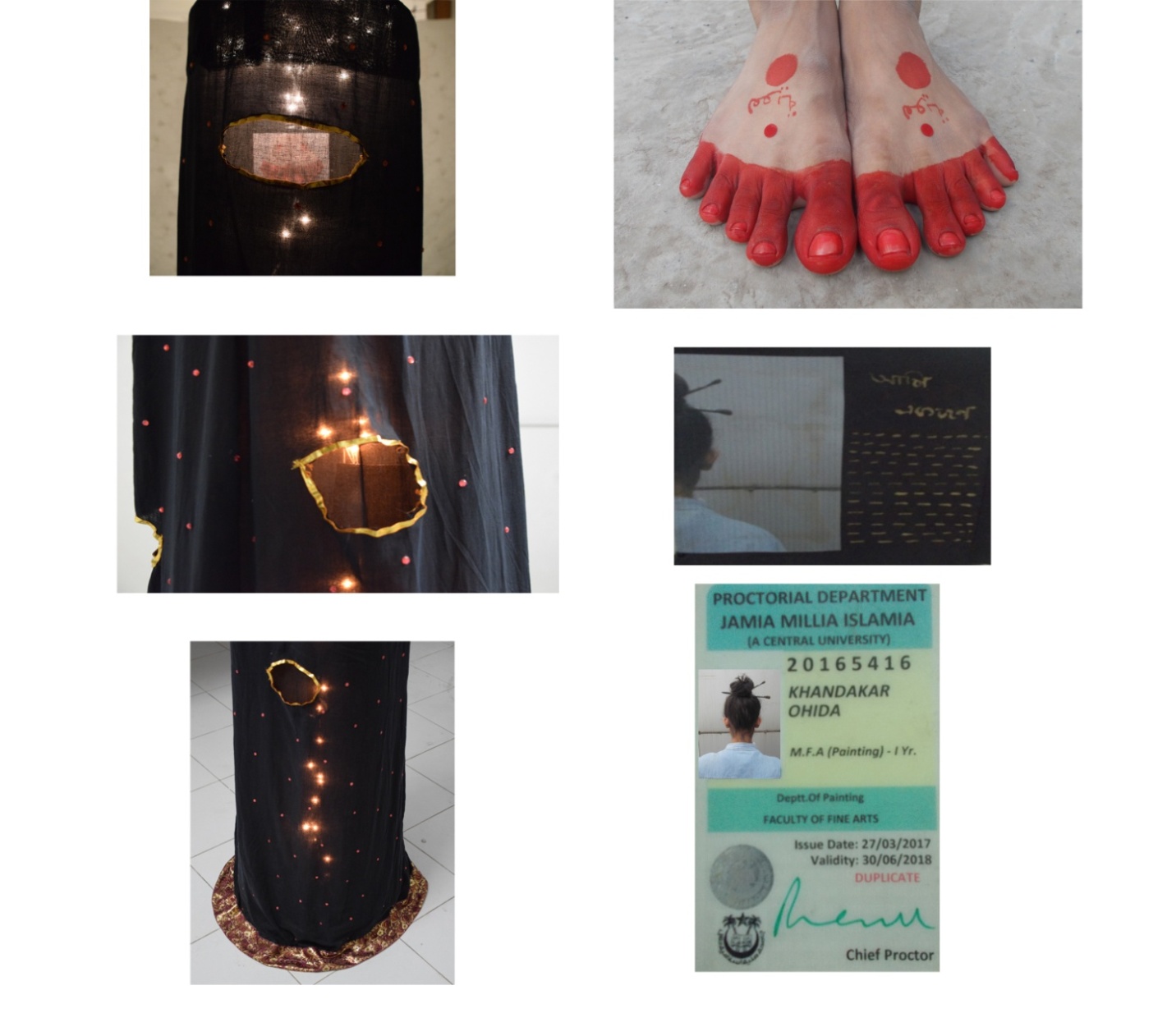
    To encourage viewer engagement and critique the concept of voyeurism, eyeholes are incorporated at various positions within the structure. These eyeholes invite viewers to intervene by peering through them an act that serves as a criticism of voyeuristic tendencies and invites viewers to question their own role in perpetuating power imbalances.
    Through this installation, the intention is to provoke reflection and dialogue about the societal structures that uphold patriarchy, and to encourage viewers to actively engage in dismantling these systems.

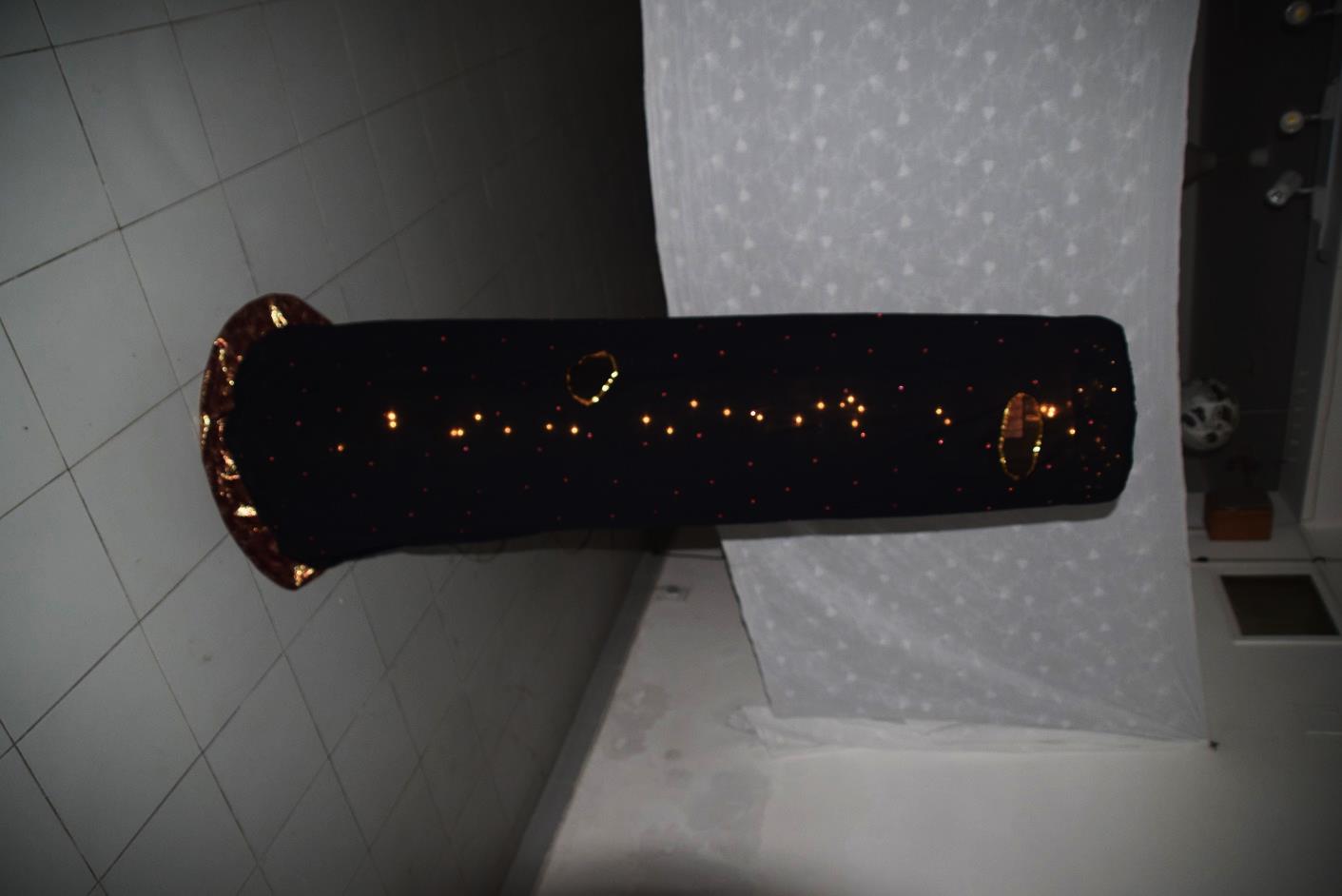
    The Home and the Globe, installation view, 2018. A tall, tapering cylindrical structure of black cloth adorned with embroidery stones and illuminated by a chain of zero-watt lights glowing through pinprick perforations. Two circular mirror-framed eyeholes are visible along the surface, inviting viewers to peer inside.
    Installation view, 2018

    Views Through the Eyeholes

    Viewed from inside the structure through the eyeholes: a photograph of Alta-painted feet, and a manipulation of a college ID card questioning identity.

    Photograph of Alta-painted feet, 4 × 3 inches, viewed from the eyehole behind the veil. The Home and the Globe installation, 2018.
    Alta-painted feet, 4 × 3 in., viewed from the eyehole
    Manipulation of a college ID card questioning identity, 5 × 2 inches, viewed from the eyehole behind the veil. The Home and the Globe installation, 2018.
    College ID card manipulation, 5 × 2 in., viewed from the eyehole
  • Exuberant Anonymity

    Exuberant Anonymity

    Installation , watercolour on Wasli board with Rehal stand, 2018

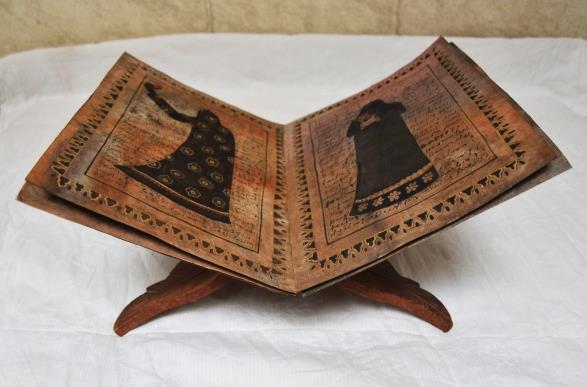
    Exuberant Anonymity (installation view), watercolour on Wasli board with Rehal stand, 2018. The open illustrated book is mounted on a traditional wooden Rehal (Quran stand), presenting the work as a sacred text. The two veiled figures face each other across the open spread, the warm terracotta ground of the pages contrasting with the dark silhouetted forms.
    Installation view on Rehal stand
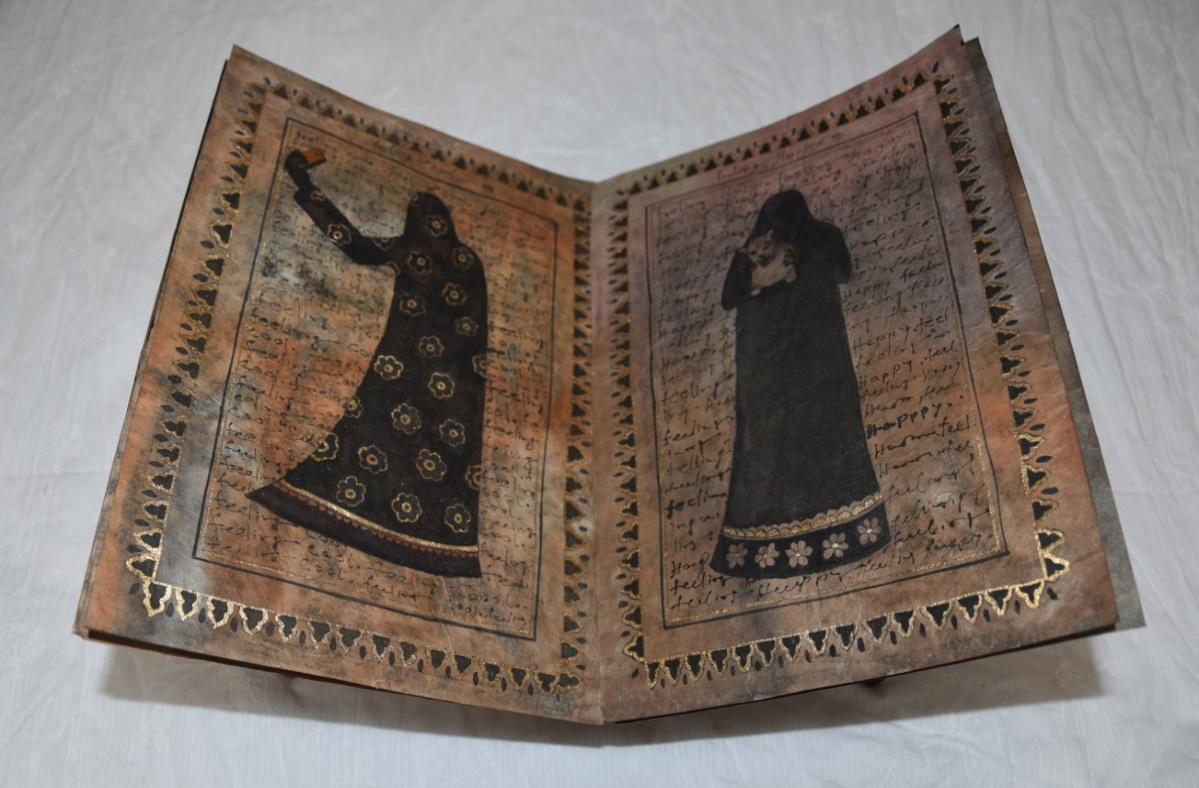
    Exuberant Anonymity (detail view), watercolour on Wasli board with Rehal stand, 2018. An open illustrated book laid flat: the left page bears a fully veiled figure in a patterned dark robe holding a phone to photograph herself; the right page depicts a second veiled figure.
    detail
  • Burden of Sorrow

    Burden of Sorrow

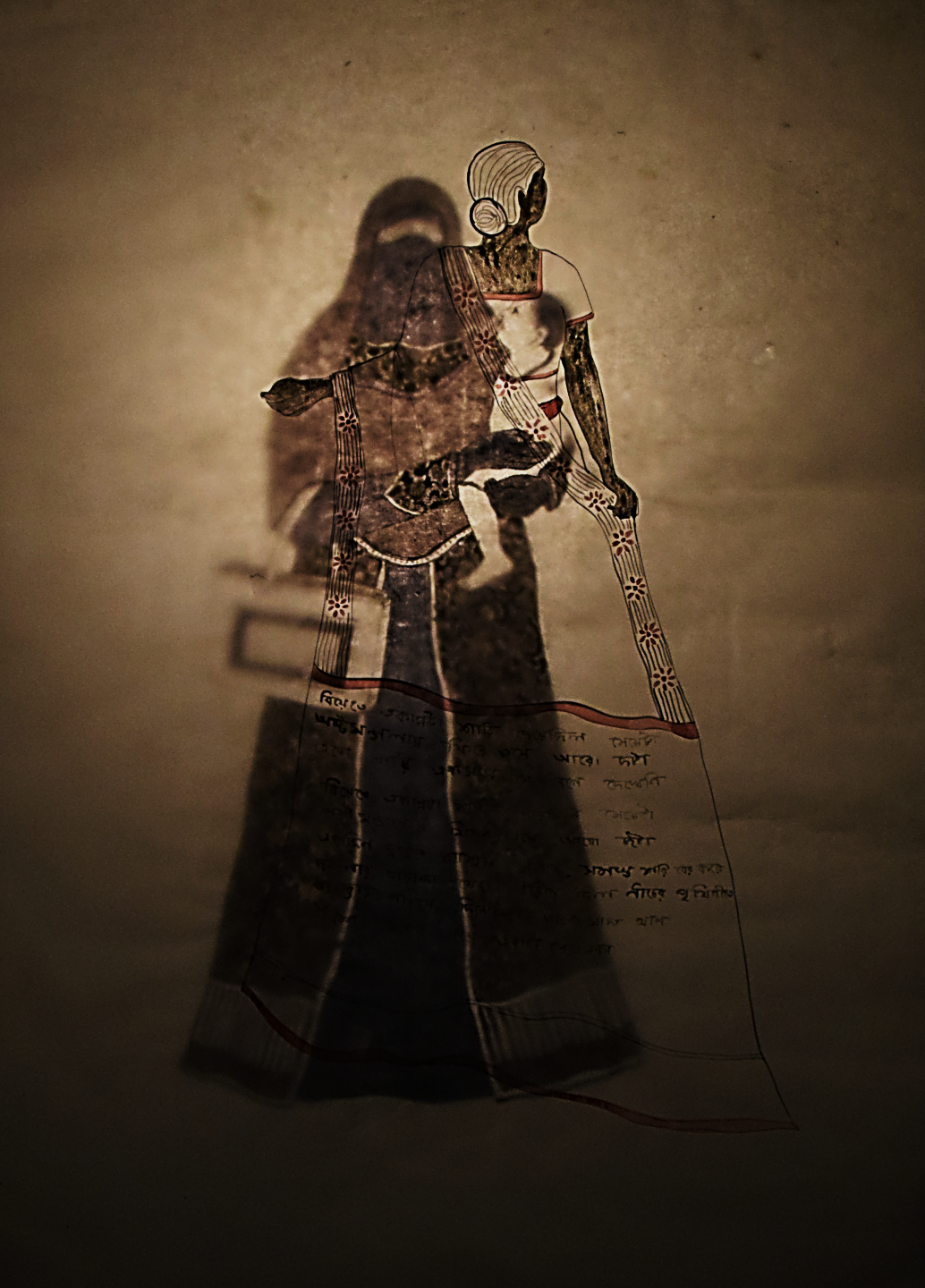
    Drawing installation , two drawings on paper with tungsten bulb backlight
    24 × 18 inches, 2018

    The artwork delves into the intricate theme of cultural identity, capturing the interplay of religious and social significance in a unique and compelling manner. It showcases the complex tapestry of diverse cultures, inviting viewers to contemplate the richness and diversity within our society.

    Burden of Sorrow, drawing installation, two drawings on paper with tungsten bulb backlight, 24 x 18 inches, 2018. Photographed in situ with backlit illumination, the layered drawings merge into a single glowing image: a fully veiled woman in an ornate dark burqa holds a small child and a long ribbon or scroll bearing Bengali script, while a second drawn layer creates a ghostly double exposure.
    Burden of Sorrow, in-situ with tungsten backlight
  • Dream of the Moro

    Dream of the Moro

    Watercolour and golden foil on paper, 16 × 24 inches each, 2018

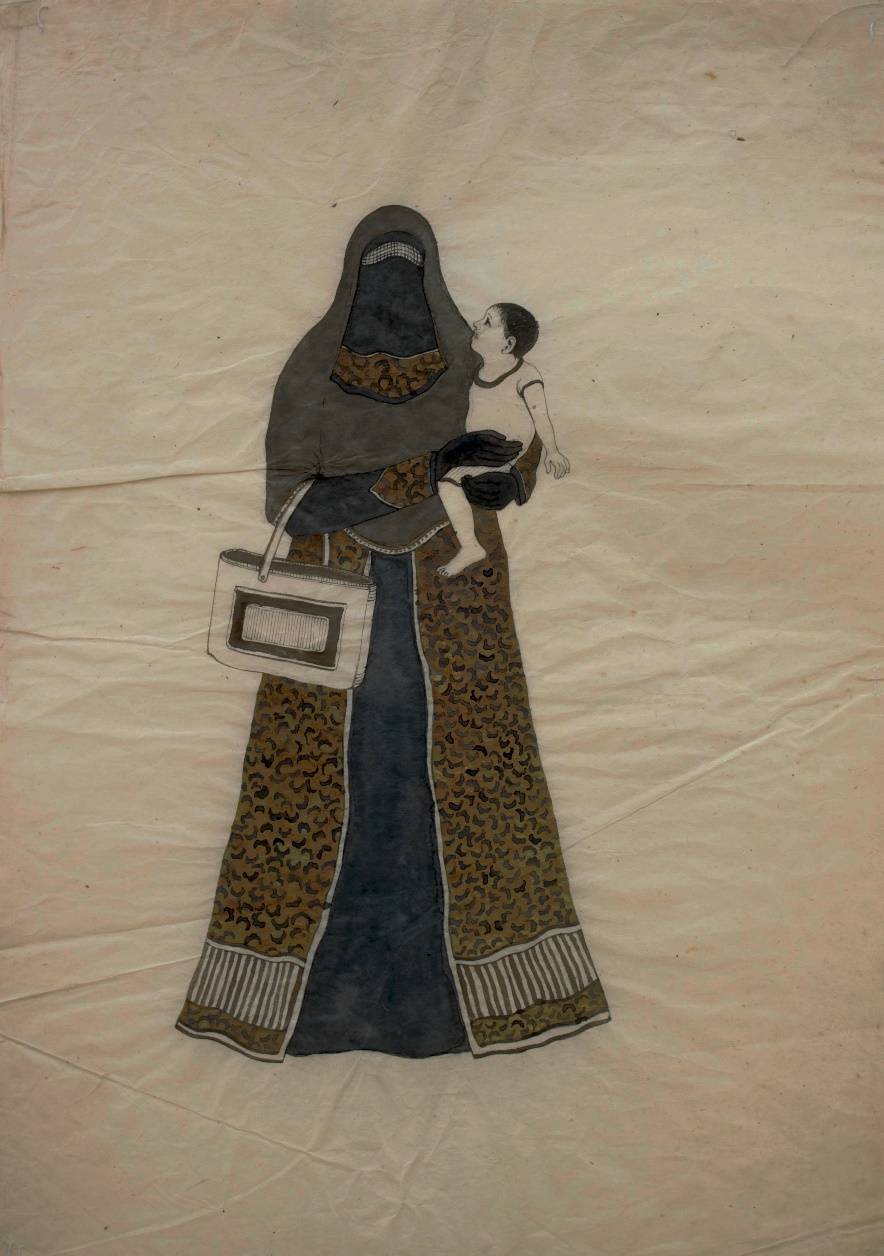
    Dream of the Moro (panel 1), watercolour and golden foil on paper, 16 x 24 inches, 2018. A veiled woman dressed in an elaborately patterned dark robe and niqab carries a naked infant in one arm and a structured handbag in the other, depicted in a flat, frontal style recalling South Asian miniature painting on raw, wrinkled paper.
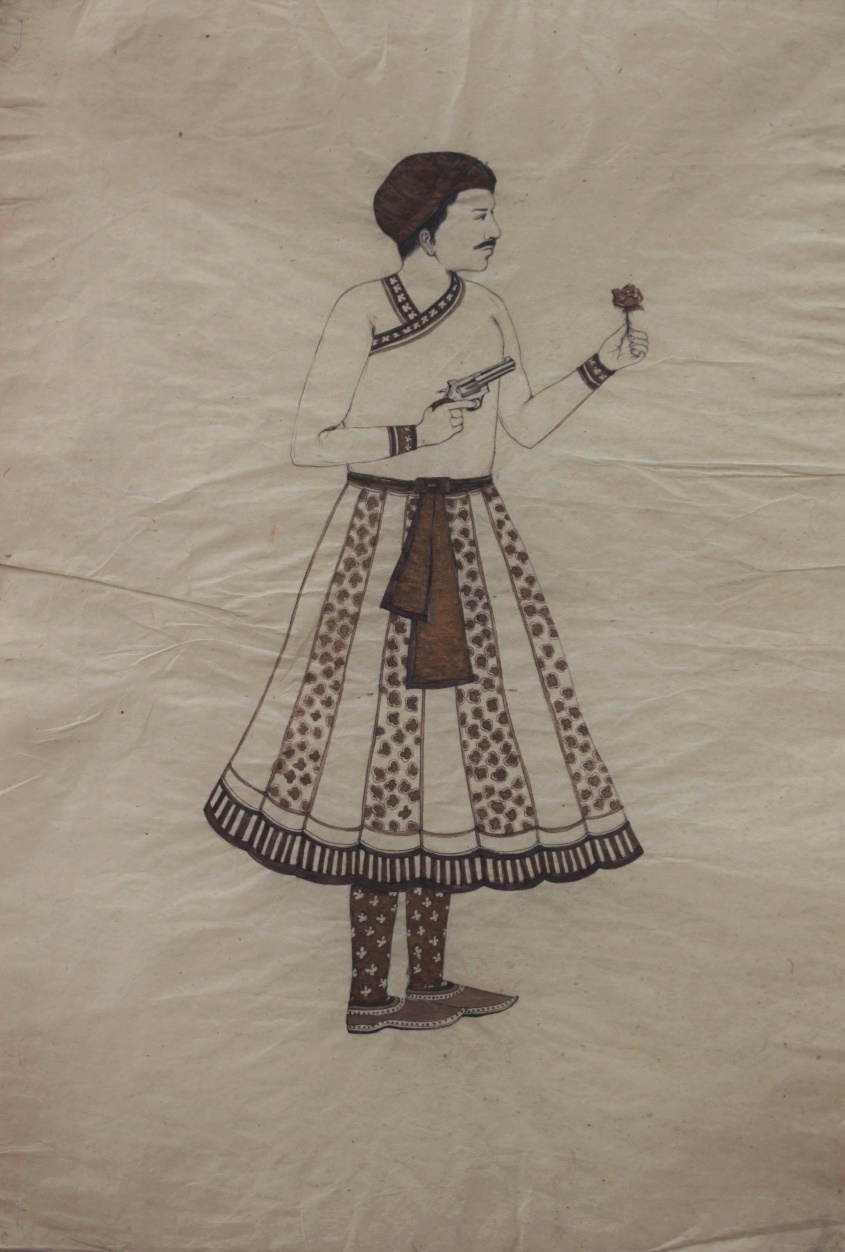
    Dream of the Moro (panel 2), watercolour and golden foil on paper, 16 x 24 inches, 2018. A solitary male figure in traditional dress — wide floral skirt, embroidered boots, and cross-body strap — holds a pistol in one hand and a small red rose in the other, rendered in fine line drawing with minimal colour washes on raw paper.
  • Leaves Are Falling

    Leaves Are Falling

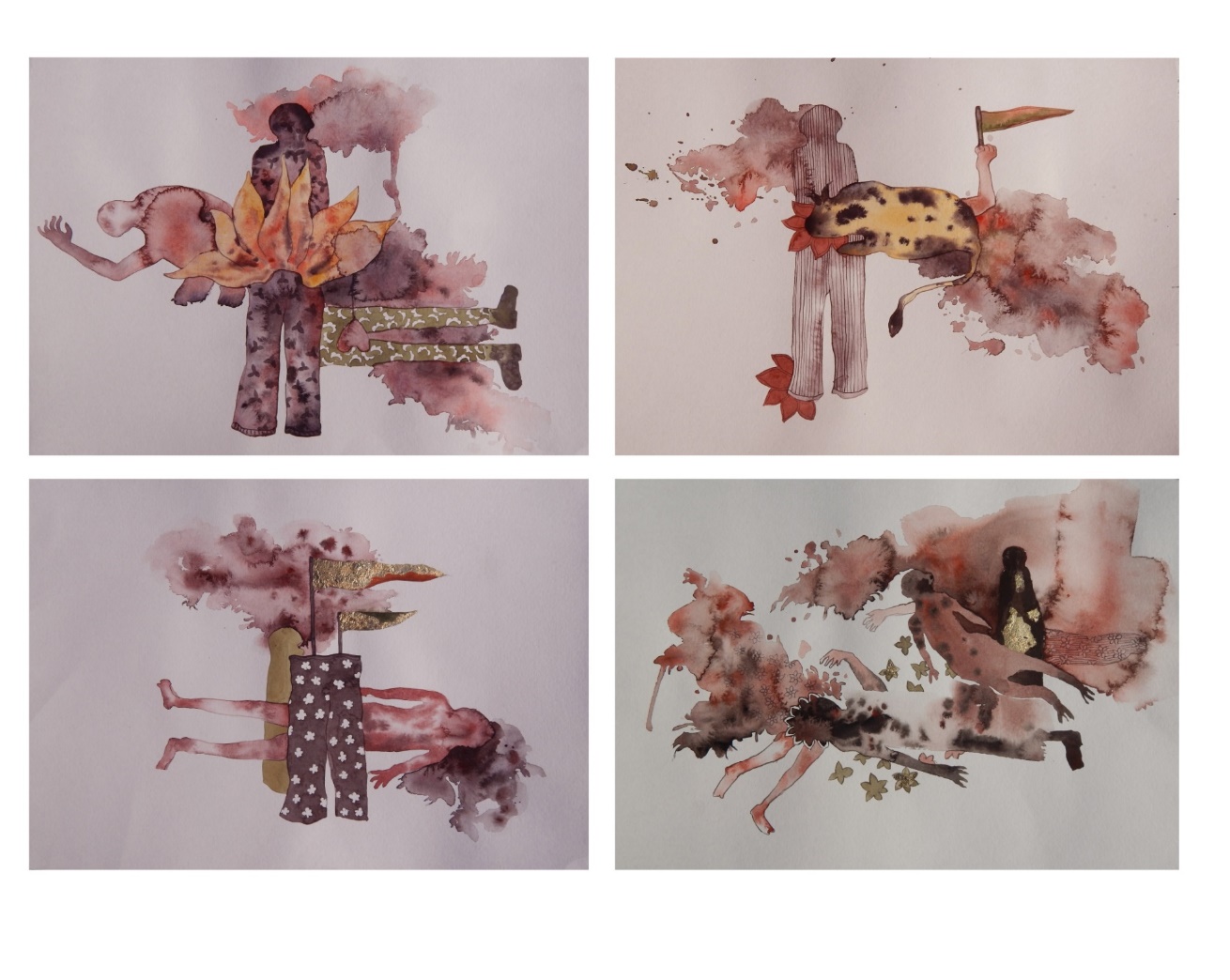
    Watercolour and gold foil on Nepali handmade paper, 24 × 16 inches each, 2018

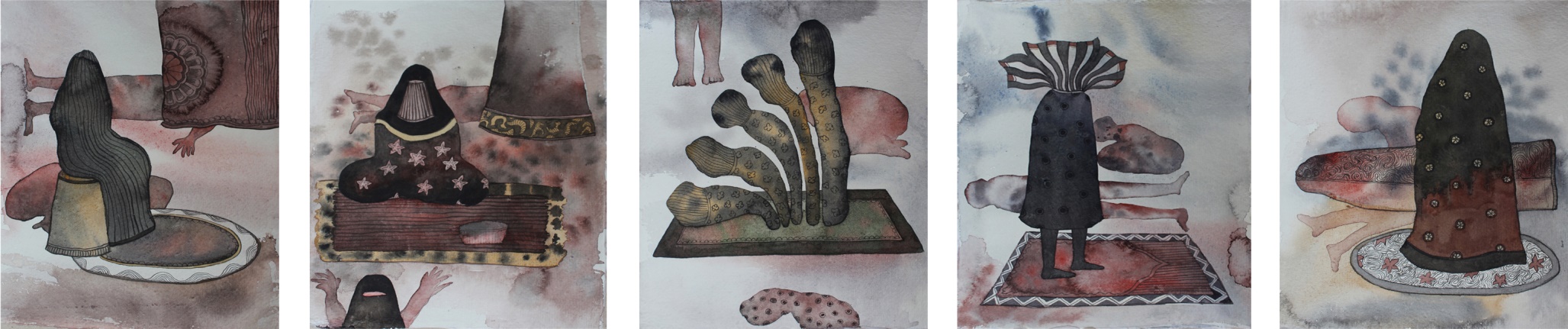
    Four works in which overlapping figures fragment into loose watercolour blooms of rose, umber, and grey punctuated by gold foil accents that suggest both adornment and dispersal. The handmade Nepali paper adds texture and unpredictability to the surfaces.

    Leaves Are Falling — four works presented together. Each painting on Nepali handmade paper shows overlapping figures fragmenting into loose watercolour blooms of rose, umber, and grey, punctuated by gold foil accents that suggest both adornment and dispersal. Watercolour and gold foil on Nepali handmade paper, 24 × 16 inches each, 2018.
    Leaves Are Falling , four works, watercolour and gold foil on Nepali handmade paper, 24 × 16 inches each, 2018